
Blog · Privacy
Talk First. Then Tap Pause.
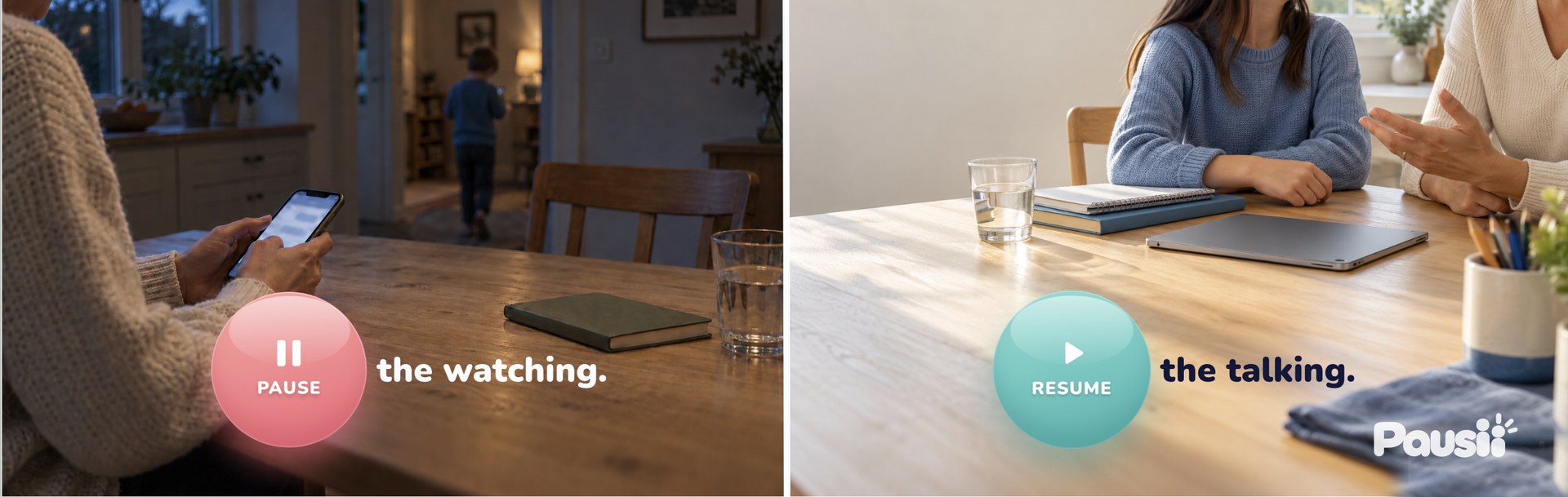
Search for “best parental control app” and you'll find two kinds of tools. Some help you set limits. Others promise to show you everything your kid does.
That second kind can read your kid's texts and chats. Some log every word they type, even messages they delete before sending. Some can record calls or turn on the camera and microphone. And some hide on your kid's phone under a boring name, like a system update.
I get the appeal. When you're worried about your kid, seeing everything feels like safety. But I spent 20 years in mobile, a lot of it in security, and that feeling is expensive.
Where all that data goes
Every message a monitoring app reads ends up somewhere, usually on the company's servers, sitting next to millions of other families' chats, photos and locations. That makes those servers a target.
In 2024, a breach at one of the best-known monitoring apps exposed data on millions of people who had bought it. A 2025 study of 20 monitoring apps found three of them sent data without basic encryption, and one shared kids' locations with an outside analytics company. Most of the 20 told parents to switch off the phone's built-in protections just to install them.
Your kid's private chats, their photos, where they go after school. Before you hand all of that to an app, it's worth asking who else might end up reading it.
Kids find out
Hidden apps don't stay hidden. Kids talk to each other, and they're good at this stuff. When they find one, they don't stop doing whatever you were worried about. They just get better at hiding it.
There's research on this too. In 2018, researchers at the University of Central Florida and Penn State found teens whose parents used monitoring apps ran into more trouble online, not less. Parents who stayed involved saw fewer problems.
The same team read hundreds of reviews kids wrote about these apps. Most gave them 2 stars or less. Kids said it felt like being watched by a stalker, and that the apps let parents skip the hard conversations. What they wanted was simple. They wanted their parents to talk to them.
Kids would rather you talk to them than spy on them.
Spying vs. pausing
Two ways to handle kids and screens.
Some parental control apps are built to see and hear everything: conversations, messages, photos, locations. That data has to live somewhere, usually on the company's servers. Kids also notice when they're being watched.
There's a better way: keep your family's data in your family, and your kid on your side.
Talk first. Then tap pause.
Controls aren't the problem
I'm not against parental controls. I built one. Apple's Screen Time is a solid foundation, and setting limits is part of the job.
What kids push back on is a secret app doing the watching so nobody has to talk. Honestly, they have a point. So when I built Pausii, I started from the other end. Could a parental control make the conversation easier instead of replacing it?
Pausing, not spying
Pausii pauses the apps you choose and brings them back later. That's the whole job.
It can't read messages or see what your kid types or browses. I built it on Apple's Screen Time tools on purpose, and your family's settings stay in your own iCloud. There's no pile of kids' messages on a Pausii server for anyone to steal, because Pausii never collects them.
It isn't hidden, either. You set it up on your kid's device together, and my twins helped design the screen they see when apps pause. Before a break, kids get “Time to wrap up” and a countdown, so they can finish the level and tell their friends they're heading out. Then dinner, homework or bed.
And if Pausii ever adds a feature that uses more data, it'll be opt-in, visible to your kids and explained first.
Talk first
In our house, we explain the why before anything changes, because kids follow rules they understand. We set it up together so nothing is a surprise. We give a heads-up before screen time ends. And when the break is over, the apps come back on time, like we said they would.
Then we tap pause.
Pause games. Resume life.
Sources
- ScienceDaily: Apps to keep children safe online may be counterproductive (University of Central Florida and Penn State, April 3, 2018)
- Ghosh et al.: A Matter of Control or Safety? Examining Parental Use of Technical Monitoring Apps on Teens' Mobile Devices (CHI 2018)
- Maier, Tanczer and Klausner: Surveillance Disguised as Protection (2025)